

There are common misconceptions about an agent and a harness, an agent and a workflow, and an agent and a bot.
So, let me start with the bot.
Do you know those annoying chat assistants on insurance websites that are supposed to help you before you speak with a human? Most of them are bots, not agents.
Traditionally, these systems have been based on keywords, decision trees, and predefined options rather than understanding context and taking actions autonomously.
Even if they do use an LLM, that alone doesn’t automatically turn them into agents. An LLM-powered chatbot can still be just a chatbot.
Now, let’s look at workflows.
Automation platforms like Make and n8n existed long before the recent rise of AI agents. They allow users to create pipelines for tasks such as sending emails, posting on social media, moving data between applications, and much more.
These workflows may or may not include LLMs in the process. Still, that doesn’t make them agents.
An agent can indeed be a bot, just as an agent can trigger workflows. But not all bots are agents, and not all workflows require agents.
Then there are agent harnesses, such as Claude, Cursor, Codex, OpenClaw, and the Hermes Agent.
These are environments built around agents: they provide the tools, interfaces, execution layers, and infrastructure needed to build and run agents without having to assemble everything yourself through raw SDKs (Software Development Kits).
So, when you pay for a product like Claude, you’re not simply paying for a “Claude agent.” You’re paying for a complete product that combines models, a harness, infrastructure, and a user experience that makes working with agents much easier.
However, not every agent harness will allow you to build the agents and workflows you’re aiming for.
You need to choose the right one for the job, and open-source solutions can often offer significantly more customization and flexibility.
In this piece, I’ll start by breaking down the differences between an agent and a harness. Then, I’ll explain the role of a Harness Engineer and how this emerging specialization can, in some cases, reduce the need for traditional AI engineering work when it comes to building and deploying agents.
Stop Calling Your Harness an “Agent”
Imagine a chat assistant where you ask a question and the output is rubbish. Now you give it a better model, and it is still hallucinating. What do you do?
What Is an Agent?
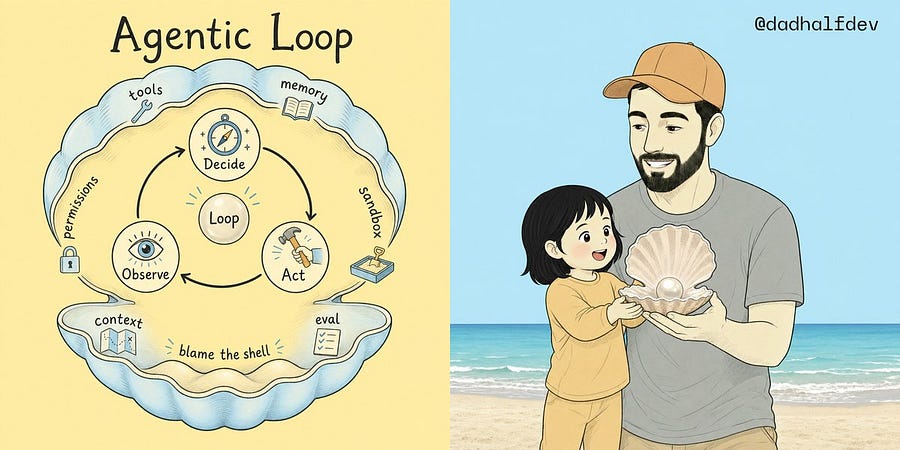
To put it simply, an agent is a model combined with a loop.
In other words, it is a script where you give a task to an LLM. Instead of “eat, sleep, rave, repeat,” as Fatboy Slim does, the model “decide, act, observe, repeat” until it reaches a goal. This cycle is what we often call the agentic process.
That loop is the seed of everything. But without a “shell” and more logic around it, it can’t do much. Similar to a brain left alone, without protection or connections to the rest of the body.
What Is a Harness?
The harness is everything around the model that makes it safe, reliable, and functional. It is the operating environment, the exoskeleton, the scaffolding.
Among other things, a harness includes:
Tools: Running a command, reading a file, calling an API, scraping a website, searching the web. All of these, and more, are considered tools. They make interaction with the “external” world possible.
Memory: Without it, the agent is amnesiac and keeps repeating itself. Different harnesses provide different memory layers.
Permissions: What the agent is allowed to do on its own, and what requires a human to approve first.
Sandboxing: Protecting API keys, internal information, and other sensitive resources, along with many other guardrails depending on the use case.
Context management: Helping the model actually fit the problem into its context window, compressing old turns, deciding what matters, and bringing the right information back when needed.
Evaluation: How you know, before letting the agent loose, that it does the right thing more often than not.
The loop itself: How you structure the decide–act–observe cycle.
Very often, the problem is not the LLM you give to the agent, but the harness around it. You can see the same model deliver very different results when running inside two different harnesses.
So don’t automatically blame the model, especially when it performs well on agentic benchmarks. Look at the harness, too.
Some Examples of Harnesses
I use three, but you probably only need one.
Take Claude. You have Claude Code, Claude Desktop, Claude Cowork, Claude Dispatch, and so on.
Anthropic has frontier models, but that’s not what makes Claude so popular. I’d bet that if Kimi ran inside Claude Desktop tomorrow, not many people would notice.
What makes it special is the ease of use, the design, and how well it handles planning, presentations, and creating artifacts.
Now, Cursor behaves differently. It started as a fork of VS Code and slowly became “the harness for developers.” Now you can do almost everything the agentic way without even having to look at the code.
And my favourite is Hermes Agent. It is a fully open-source harness, like OpenClaw, that allows you to do, well, almost anything.
It is not as simple to get started with as Claude, and it is not as polished for coding as Cursor. But it offers almost unlimited customization. You can connect to multiple gateways, use countless inference providers, run it using local models, connect to home devices, create enterprise applications, and so on.
With Claude and Cursor, there is relatively little harness engineering you can do because they are closed environments. With Hermes, there are no limits.
Don’t Hire AI Engineers to Build Agents
I see many job postings for AI Engineers to build agents.
The stack often includes LangChain agents or Google’s ADK (Agent Development Kit), along with expertise in RAG (Retrieval-Augmented Generation) systems.
It’s great that the market is still looking for these specialists. But do we really need AI Engineers to build agents from scratch?
The difficulty of building an agent nowadays isn’t necessarily in mastering Python libraries and SDKs. Tools like Claude and Cursor can handle a significant amount of that implementation work (yes vibe coding!).
The real challenge is often building the harness around the agent: everything related to tools, memory layers, sessions, guardrails, execution, permissions, and so on.
This is where Harness Engineering comes in.
Harness Engineering is an emerging specialization within AI Engineering. They can either build tailored harnesses around your agents or configure and extend existing ones.
AI Engineering
An AI engineer is the person who turns an LLM into something a company can actually use.
Some AI engineers come from backend development or data science, since the field involves data manipulation, statistics, and machine learning.
However, you don’t necessarily need deep expertise in machine learning or deep learning to work as an AI engineer. The role is often focused on RAG pipelines, LLM integration, AI agents, function calling, and vector databases.
The most popular programming language among AI engineers is Python, and the stack often includes LangChain, LangGraph, LlamaIndex, agent SDKs, LLM APIs, and some DevOps knowledge.
It’s also one of the fastest-growing jobs in the US right now. LinkedIn ranks it number one, with 143% more postings than a year ago.
The job can consist of the following:
Wiring an LLM into a product or pipeline, often using Prompt Engineering, or more recently, Context Engineering.
Using multimodal LLM solutions for data enrichment, video creation, image generation, audio integration, and more.
Creating RAG systems by breaking documents into chunks, embedding them, storing those embeddings in a vector database, and retrieving the relevant information when someone asks a question.
Building AI agents using frameworks such as LangChain, Google’s ADK, and other agent libraries. This also increasingly requires an understanding of agent harnesses.
The list can go on. These are just a few examples, and as the field continues to grow, new sub-roles and specializations are emerging, such as Loop Engineering and Context Engineering.
Even Harness Engineering can be viewed as a specialization within AI Engineering. However, while many AI engineers can perform this type of work, the opposite isn’t necessarily true.
Harness Engineering
A Harness Engineer does not build the agent from scratch.
They configure, extend, and deploy agents inside an existing harness. Companies are already hiring for this exact title, sometimes listed as “Software Engineer, Agent Harness”, “Agent Infrastructure”, or even “AI Engineer”.
The job descriptions typically involve experience with execution runtimes, guardrails, model routing, memory systems, session management, tool integrations, MCP (Model Context Protocol), and more.
In other words, it’s everything that surrounds the agent and allows it to actually do useful work.
If you’re using Claude, Codex, or Cursor, you’re probably already doing a bit of harness engineering.
But things get more complicated when you need more specific use cases, often achievable with open-source harnesses like the Hermes Agent or OpenClaw.
Let’s separate Harness Engineering into three tiers:
Tier 1: Creates skills, integrations, and small modifications to existing open-source or closed-source harnesses.
Tier 2: Takes an existing open-source harness and uses it to build a custom agent for a specific use case.
Tier 3: Builds the agent harness itself, including the underlying runtime, tooling, memory, routing, permissions, and other infrastructure.
Right now, Tier 2 engineers can build all sorts of specialized agents without necessarily having the skills required in Tier 3.
That can make them extremely valuable to companies because they can ship custom agents faster.
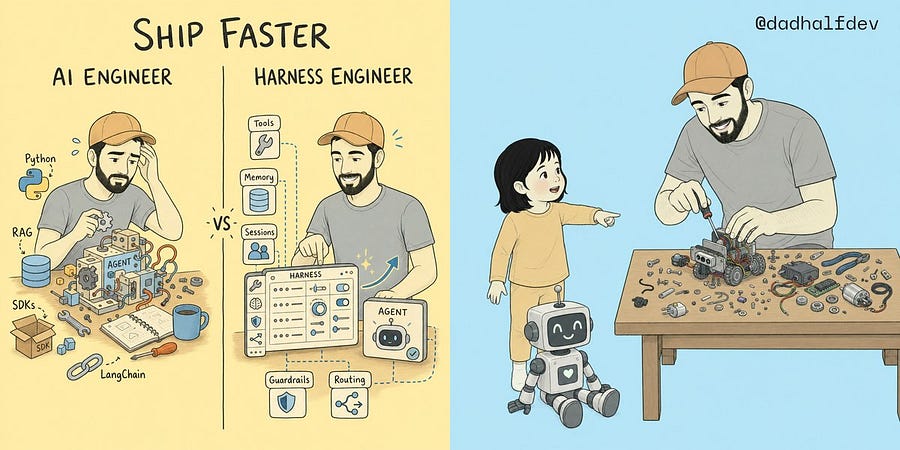
Instead of reinventing the infrastructure, Tier 2 specialists can master existing open-source harnesses and adapt them to the customer’s needs.
I run a small agency that does exactly that! Meet tuik.
Having issues building an agent? There’s no need to get frustrated. Book a 20-minute consultation, and let’s find a solution together:
Conclusion
In this piece, we’ve covered the differences between AI Engineering and Harness Engineering.
While Harness Engineering can fit within AI Engineering, it also encompasses many areas traditionally associated with Software Engineering.
The rise of open-source harnesses has made it possible to build all kinds of agents without being as constrained by the limitations of a particular commercial harness, as can happen with products such as Claude, Cursor, and Codex.
People are already building agents to automate their personal and professional lives, create social media content, scrape information from the web, deliver daily briefings, control home devices, run outreach campaigns, work with local or less-restricted models, and much more.
Some of these things can be done with Claude, Cursor, or Codex. But there are limits to how much you can customize the underlying system.
This is where Harness Engineers can add value. They can identify the right harness for a particular use case, customize and extend it, and ship a working agent much faster than building the entire infrastructure from scratch with raw SDKs.
Building agents now takes days, not months!
Quite possibly the most on point article for AI to read this year. Right now.
Thank you !